





Introduction
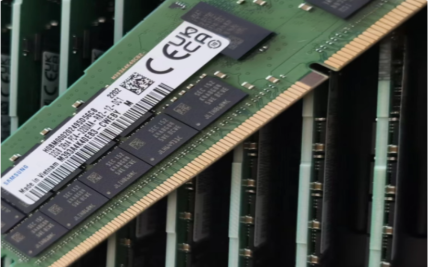
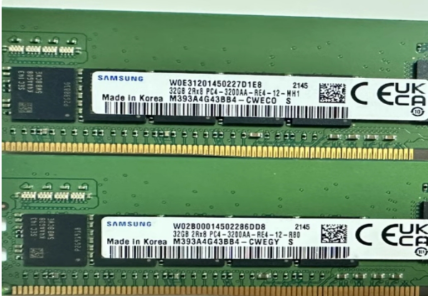
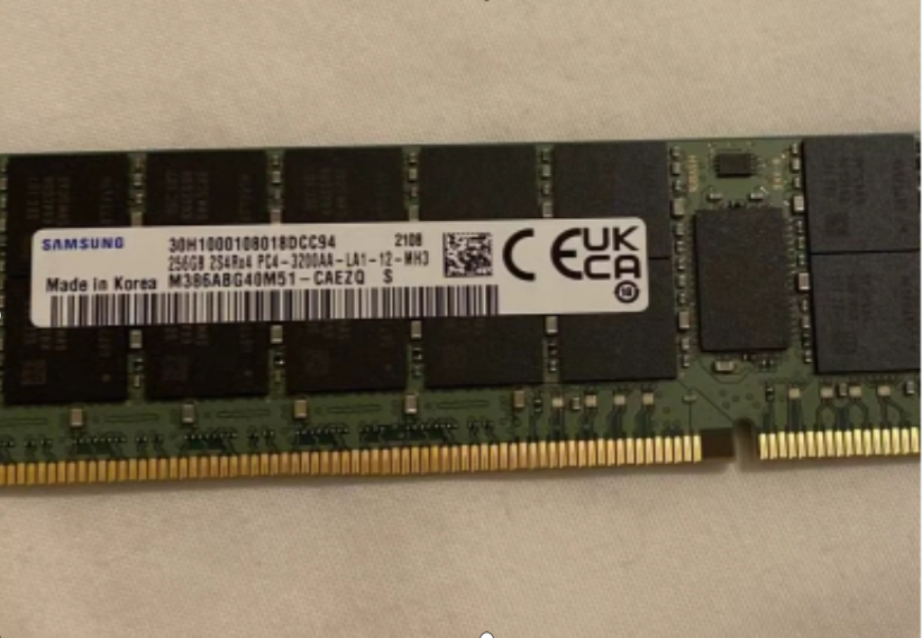
The Samsung M393ABG40M52-CAE is a 256GB DDR4-3200 ECC Registered DIMM for compatible enterprise servers. Its high-density 8Rx4 organization makes it a special server memory module. Buyers should check more than capacity and speed. They need to do this before they use it as a replacement or expansion module.
Public supplier specifications list this model as a PC4-25600 registered RDIMM with ECC support. It has CL22 timing. It uses 1.2V operation. It comes in a 288-pin DIMM form factor. These details set it apart from lower-density DDR4 RDIMMs. They also separate it from LRDIMMs. They keep it distinct from unbuffered desktop or workstation modules that may share the same headline speed.
At 3200 MT/s, DDR4-3200 gives up to 25.6 GB/s of possible transfer bandwidth per 64-bit memory channel. Actual operating speed still depends on several factors. It depends on processor memory-controller support. It depends on BIOS qualification. It depends on DIMMs per channel and population order. It also depends on whether the system mixes modules with different ratings.
The 256GB capacity works well for virtualization hosts. It fits database servers. It suits analytics nodes and in-memory caching. It also fits dense compute platforms where memory size is often the main limit. Using fewer high-capacity DIMMs can help keep open slots for later expansion. This works when the platform supports the required rank and 3DS registered configuration.
This module is registered ECC server memory. It should be matched against the server vendor’s qualified memory list and population rules before installation. Compare module type, capacity, rank count, device width, speed grade, voltage, and part number. RDIMM, LRDIMM, and UDIMM technologies should not be mixed. The only exception is when the server documentation clearly allows the setup.
For exact-part sourcing, memory upgrade planning, and server memory compatibility, Huaying Hengtong can help customers compare Samsung server memory by model number, capacity, rank structure, module type, and target platform. This support covers virtualization server memory and database server memory as well.
Specifications
|
Product Model |
M393ABG40M52-CAE |
|
Memory Type |
DDR4 SDRAM |
|
Module Type |
Registered DIMM / RDIMM |
|
Application |
Server |
|
Capacity |
256GB |
|
Memory Speed |
3200 MT/s |
|
Speed Classification |
DDR4-3200 / PC4-25600R |
|
Memory Organization |
8Rx4 |
|
Rank Structure |
Octal-rank / 3DS registered |
|
Error Correction |
ECC Supported |
|
CAS Latency |
CL22 |
|
Operating Voltage |
1.2V |
|
Form Factor |
288-pin DIMM |