


Choosing an InfiniBand switch for an AI cluster is less about chasing the largest number on a data sheet and more about matching link speed, port density, topology, and growth plans. A 200G HDR fabric can suit a defined cluster size, but it is not automatically sufficient for every training platform. The key question is whether it can keep accelerator traffic moving as the cluster expands.
What 200G HDR Means for AI Networking
Bandwidth Is Only the First Test
200G HDR describes the speed of each InfiniBand connection, not the performance of an entire cluster. Real results depend on how many links are active, whether traffic is balanced, how the fabric is oversubscribed, and whether the servers and adapters can use the available bandwidth. For distributed training, the switch must handle repeated east-west exchanges between compute nodes, not only occasional storage or management traffic.
An HDR link can therefore be enough when the cluster is designed around that generation of adapters and the application does not require a newer fabric speed. It may be a poor fit when the plan already assumes 400G-class uplinks, very large all-reduce jobs, or a rapid move to a denser accelerator pod. Capacity should be evaluated at the fabric level: per-port rate, aggregate switching capacity, cable topology, and the number of reachable endpoints all matter together.
Port Density Changes the Equation
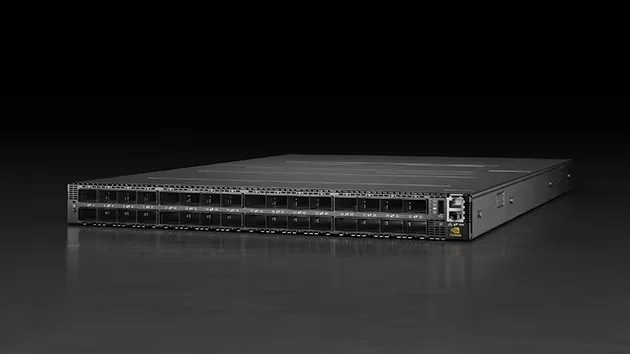
The NVIDIA MQM8790-HS2F is a 1U HDR 200Gb/s InfiniBand switch in the Quantum family. Its documented configuration provides 40 QSFP56 ports for 200Gb/s HDR InfiniBand, and compatible splitter cables can convert those connections into 80 HDR100 100Gb/s ports. That flexibility can help a team connect fewer high-speed nodes today while preserving a path for more 100G endpoints where the design calls for it.
The same product record lists 16Tb/s of aggregate switching capacity and port-to-port switching delay below 130ns. The 40 QSFP56 connections are bidirectional. The product record also lists VL2VL mapping for QoS prioritization of latency-sensitive network traffic. These capabilities are useful design inputs, but they do not remove the need to benchmark the completed fabric.
The record further describes SHARP as offloading collective operations to switch hardware, with CPU-overhead reduction of up to 30% for supported workloads. It identifies adaptive routing for SlimFly and Dragonfly+ topologies. These functions matter most when many nodes exchange data at once.
The split-port option changes endpoint attachment and can affect oversubscription, cable management, and fault domains. Map the intended leaf, spine, or rail layout before counting ports as available capacity.
When the MQM8790-HS2F Is Enough
A Good Fit for Defined HDR Pods
The MQM8790-HS2F is designed for hyperscale computing and AI-driven workloads. It is a sensible candidate for an AI or HPC pod standardized on 200G HDR. It is also relevant when existing infrastructure uses 100G EDR, 56G FDR, or 40G QDR, because the documented switch supports backward-compatible connections to those InfiniBand standards. Adapter, cable, and software compatibility still need testing.
For a fixed-size deployment, calculate ports consumed by compute nodes, uplinks, management, and spare capacity. Its 1U form factor and 40-port layout provide a clear planning baseline. A switch that is technically fast enough but filled on day one may still be the wrong operational choice.
Where It Stops Being Enough
200G HDR becomes less attractive when the cluster roadmap depends on higher-radix 400G links, frequent scale-out between multiple pods, or a uniform next-generation fabric. In those cases, compare the switch with the required adapter generation, rail design, collective-communication pattern, and upgrade window.
A practical test is to model the busiest job rather than the average job. Include gradient synchronization and checkpoint traffic. If those flows compete for the same links, nominal 200G line rate will not describe the user experience.
Design and Cabling Considerations
Where InfiniBand Fits in the Architecture
An AI fabric should be planned as a system of switches, adapters, cables, firmware, and orchestration. The InfiniBand network devices category is a useful starting point for checking adjacent components and available form factors. Keep the model-specific assumptions separate from general category information: the MQM8790-HS2F facts above come from the product record, while the final design must be validated against the actual bill of materials.
Cable length and breakout choice deserve early attention. QSFP56 ports support high-density connections, but a splitter layout can create a different service pattern from a direct 200G link. Label both ends, reserve bend radius, and document which logical ports belong to each server group. Clear port maps make replacement and fault isolation much faster during a training run.
Validate Power, Cooling, and Space
The switch uses a 1U rack-mountable form factor, so rack height is straightforward. The harder checks are power-feed availability, airflow direction, transceiver temperature, and the distance to connected servers.
Before ordering, confirm the rack layout, outlet type, optical or copper media, and the supported firmware combination. We can help translate a port plan into a practical procurement checklist, including spare cables and the replacement path for legacy endpoints. That service step matters because a correct switch with an incomplete deployment kit still creates schedule risk.
The product record describes a 1U rack-mountable chassis measuring 43.6 mm high, 433.2 mm wide, and 590.6 mm deep. It also lists 1+1 redundant hot-swappable power supplies, N+1 redundant hot-swappable fans, and typical consumption of 122W. The listed power supplies are 80+ Gold/Energy Star-certified.

Plan for Growth Beyond the First Rack
Count Expansion Ports, Not Just Compute Ports
The first rack often looks simple: connect the servers, reserve a few ports, and start testing. Expansion changes the calculation. Uplinks, redundant paths, service nodes, and future racks can consume more ports than expected. Use the network device portfolio to compare the surrounding switching options, but keep the deployment decision tied to the required InfiniBand topology and validated compatibility.
If the next phase may use a different speed generation, decide whether the current switch will remain an edge device, a leaf, or a temporary bridge. A staged plan is economical only if the cabling and addressing model tolerate the transition.
Choose HDR with a Clear Upgrade Boundary
HDR is enough when it meets the workload, endpoint, and growth requirements documented for the current phase. It is not enough when it is selected only because 200G sounds large. Set a review point based on node count, job size, link utilization, or the next accelerator refresh. At that point, reassess the fabric rather than assuming a simple port swap will solve congestion.
Procurement and Validation Checklist
Validate the Whole Deployment
Huaying Hengtong can support a review that connects the switch specification with the rack, adapter, cable, and expansion plan. Our team can check whether the proposed port map leaves useful spare capacity. For a broader planning discussion, review the AI infrastructure solutions available for data-center deployments.
Document the Acceptance Test
Before approval, record the exact model, port mode, breakout requirement, firmware baseline, power arrangement, and acceptance test. Then test the highest-value communication pattern with the intended nodes. This produces a defensible answer: 200G HDR is enough when it sustains the planned workload and leaves a credible upgrade path.
FAQ
Q: Is NVIDIA MQM8790-HS2F suitable for a modern AI cluster?
A: It can be suitable for a modern AI cluster that is designed around 200G HDR, has a compatible InfiniBand stack, and fits within the switch’s port and topology limits. The decision should include future expansion rather than speed alone.
Q: How many ports does NVIDIA MQM8790-HS2F provide?
A: The documented configuration provides 40 QSFP56 ports for 200Gb/s HDR InfiniBand. With compatible splitter cables, those connections can be used as 80 HDR100 100Gb/s ports.
Q: Can NVIDIA MQM8790-HS2F connect to older InfiniBand equipment?
A: The product record lists support for 40G QDR, 56G FDR, and 100G EDR as legacy InfiniBand standards. Actual interoperability still depends on adapters, cables, firmware, and the selected port mode.
Q: When is 200G HDR not enough for an AI cluster?
A: It may be insufficient when the roadmap requires 400G-class uplinks, very large multi-pod collective workloads, or a single uniform next-generation fabric. In that case, evaluate the complete topology and upgrade path.
Q: What should buyers check before ordering NVIDIA MQM8790-HS2F?
A: Confirm the exact port plan, splitter needs, adapter compatibility, cable lengths, firmware, power and cooling, rack space, spare capacity, and an acceptance test using the intended workload.