


Why Enterprise HDD Performance Still Matters in 2026
AI modeling, big data analytics, and hybrid cloud environments continue to grow. The total amount of data produced is very large. Flash storage often receives the most industry attention. Yet enterprise hard disk drives (HDDs) remain the main foundation of cost-effective, high-capacity storage. IT architects need to understand the mechanics behind their efficiency. This knowledge is very important for designing modern data centers. The right mechanical drive strategy stops serious infrastructure bottlenecks.
What Factors Affect Enterprise HDD Performance Most?
HDD Read Speed, Write Speed, and Real Throughput
Sustained HDD read speed and write capabilities are determined by spindle speed, interface bandwidth, and areal density. High-density magnetic platters let the read/write heads access more data per revolution. This process directly increases real-world throughput. It does so without requiring higher rotational speeds.
Reliability, Heat, and Continuous Operation
Enterprise environments need 24/7 uptime under heavy loads. Drives that use advanced helium-sealed technology have much less internal friction. This reduces heat generation and power consumption. The thermal efficiency is very important. It keeps performance steady and prevents the drive from thermal throttling during intensive operations.
Capacity, Density, and System Architecture
System architecture greatly affects how drives perform under load. SAS (Serial Attached SCSI) interfaces offer full-duplex communication and deeper command queues compared to standard SATA. These features prevent data traffic jams in dense, multi-drive server arrays. They also improve overall hardware responsiveness.
How Workload Type Changes HDD Performance Requirements
Hot, Warm, and Cold Data Access
Modern storage architectures categorize data by access frequency. Warm and cold data, such as medical archives, compliance backups, or financial logs, do not require instantaneous transactional access. They do demand massive capacity and strong data retention reliability.
Sequential vs Random Read/Write Patterns
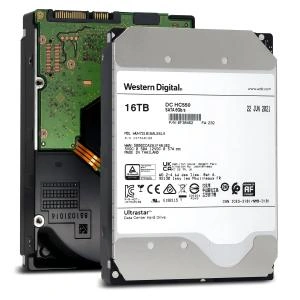
HDDs mechanically excel at sequential workloads like video streaming or large file transfers. For instance, large-scale deployments utilizing the Western Digital WUH721816ALE6L4 deliver excellent sequential throughput for 16TB SATA requirements in distributed file systems. On the other hand, highly random I/O patterns can cause mechanical head thrashing. This reduces efficiency and increases latency.
Backup, Archive, Surveillance, and Cloud Storage Needs
Surveillance and backup tasks require continuous, sustained write capabilities. The use of drives with Conventional Magnetic Recording (CMR) ensures data is written reliably. It avoids the performance penalties and rebuilding times associated with overlapping magnetic data tracks.
HDD vs SSD: What This Comparison Means for HDD Performance
HDD vs SSD Speed Comparison 2026: Where the Gap Matters
When analyzing any HDD vs SSD speed comparison 2026, solid-state drives clearly win in random IOPS and ultra-low latency. However, for massive sequential data streams, modern enterprise HDDs maintain competitive throughput. They do this at a fraction of the cost per terabyte. This approach bridges the gap where sheer capacity matters more than microsecond response times.
Why SSD Speed Does Not Replace Every HDD Use Case
It is simply not economically viable to store petabytes of inactive or archival data on NVMe SSDs. The large cost difference means that HDDs are irreplaceable for deep disaster recovery, regulatory compliance archives, and deep-tier cloud repositories.
Why Many Enterprise Systems Still Use Tiered Storage
A hybrid approach improves both performance and budget. Hot, active data resides on high-speed flash arrays. At the same time, automated systems migrate cold data to dense HDD enclosures. This method makes full use of the architectural strengths of both storage mediums.
How to Evaluate Enterprise HDD Performance, Beyond Speed
HDD Performance Benchmarks 2026: What Numbers Should You Check?
Analyzing HDD performance benchmarks 2026 requires looking past peak transfer rates. True enterprise evaluation involves assessing the Mean Time Between Failures (MTBF), workload rate limits (frequently 550TB/year), and power consumption metrics under continuous load.
Why RPM and Capacity Alone Are Not Enough
A 7200 RPM spec is typical, but the real magic that keeps it from being a drag is the multi-tier caching, as well as the rotational vibration (RV) sensors in the drives to account for the natural wobble in the disk during high-density server room deployments to keep the system from slowing down.
How to Balance Performance, Stability, and Long-Term Use
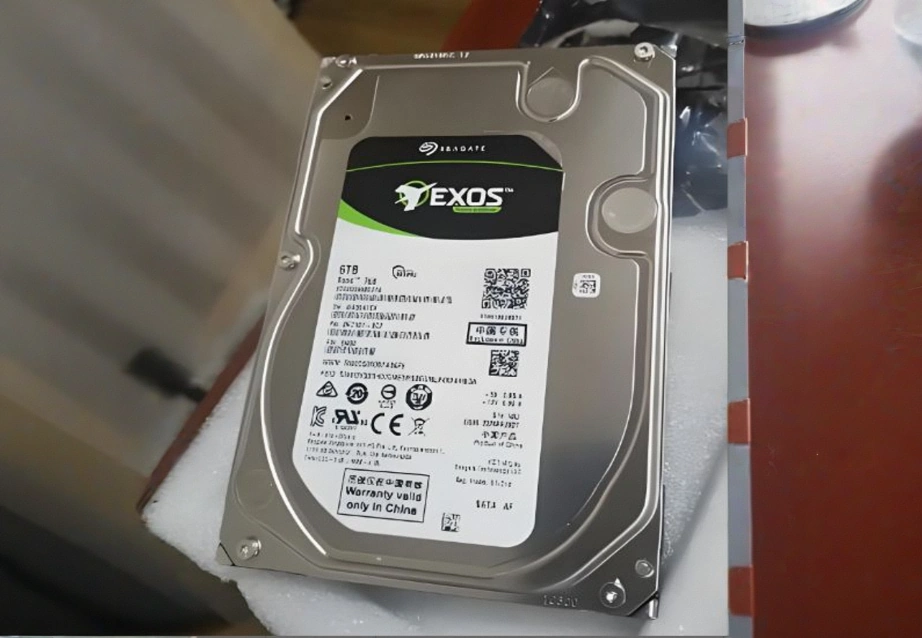
Enterprise drives like the Seagate ST16000NM004J showcase this balance well. They combine a massive 16TB capacity with a SAS 12Gbps interface and a 256MB cache. This offers the necessary bandwidth, error correction, and vibration tolerance for long-term stability in complex arrays.
How to Match Enterprise HDDs to Real Business Scenarios
Data Centers and Cloud Storage
Hyperscale environments require drives that balance high capacity with strict energy efficiency. This helps control operational expenditures and cooling costs across thousands of server racks.
Backup, Archive, and AI Data Sets
AI training requires massive historical datasets. HDDs provide the necessary repository space to economically house these petabytes of raw data. The data is then filtered and moved to faster tiers for active algorithmic processing.
Servers, Surveillance, and High-Volume File Storage
For video surveillance, continuous write streams demand specific firmware optimizations to prevent frame dropping. These optimizations strictly prioritize write stability and continuous operation over burst read speeds.
Common Mistakes When Choosing Enterprise HDDs
A frequent architectural error is deploying desktop-grade hard drives in enterprise servers to save upfront costs. This leads to premature mechanical failures due to rotational vibration. Another mistake is mismatching interfaces. This occurs when using SATA, where a dual-port SAS architecture is strictly required for enterprise failover redundancy.
Why Consider Huaying Hengtong for Enterprise HDD Solutions
Established in 2016, we at Beijing Huaying Hengtong Technology Co., Ltd. understand that building a resilient IT infrastructure requires the right hardware foundation. We provide users with original standard products from major manufacturers, including Dell, HPE, Lenovo, Huawei, and Seagate. This ensures complete original quality assurance. With rich management experience and a complete sales channel, we deliver customized information technology solutions tailored exactly to your demand analysis, equipment selection, and continuous operation needs.
FAQ
Q: What are the standard HDD performance benchmarks for data centers in 2026?
A: In 2026, standard benchmarks focus heavily on sustained sequential transfer rates (often exceeding 250MB/s), workload ratings of 550TB/year, and operational stability metrics like IOPS per watt. They look at these measures rather than just isolated burst speeds.
Q: How can I optimize HDD read speed in an enterprise NAS?
A: To optimize read speeds, ensure you are using enterprise-class drives with CMR technology and large onboard caches. You should implement proper RAID configurations (such as RAID 10). You should also utilize a tiered storage architecture where SSDs act as a high-speed cache for the mechanical array.
Q: What is the true HDD vs. SSD speed comparison 2026 for archive workloads?
A: While an HDD vs SSD speed comparison 2026 shows SSDs dominating random read/write tasks, high-capacity HDDs provide completely sufficient throughput speeds for pure archive workloads consisting of large sequential files. They are also vastly more cost-effective per terabyte.
Q: Does a higher HDD read speed matter for video surveillance storage?
A: For video surveillance, sustained continuous write speed is actually more critical than HDD read speed to prevent frame loss during recording. However, strong read speeds become highly important during video playback, querying, and exporting large video archives.
Q: How do HDD performance benchmarks 2026 impact tiered cloud storage?
A: The latest HDD performance benchmarks 2026 help IT architects calculate exact latency and throughput expectations for the “warm” and “cold” tiers of cloud storage. They allow them to precisely balance SSD deployments for active data with HDD arrays for massive, economical capacity.